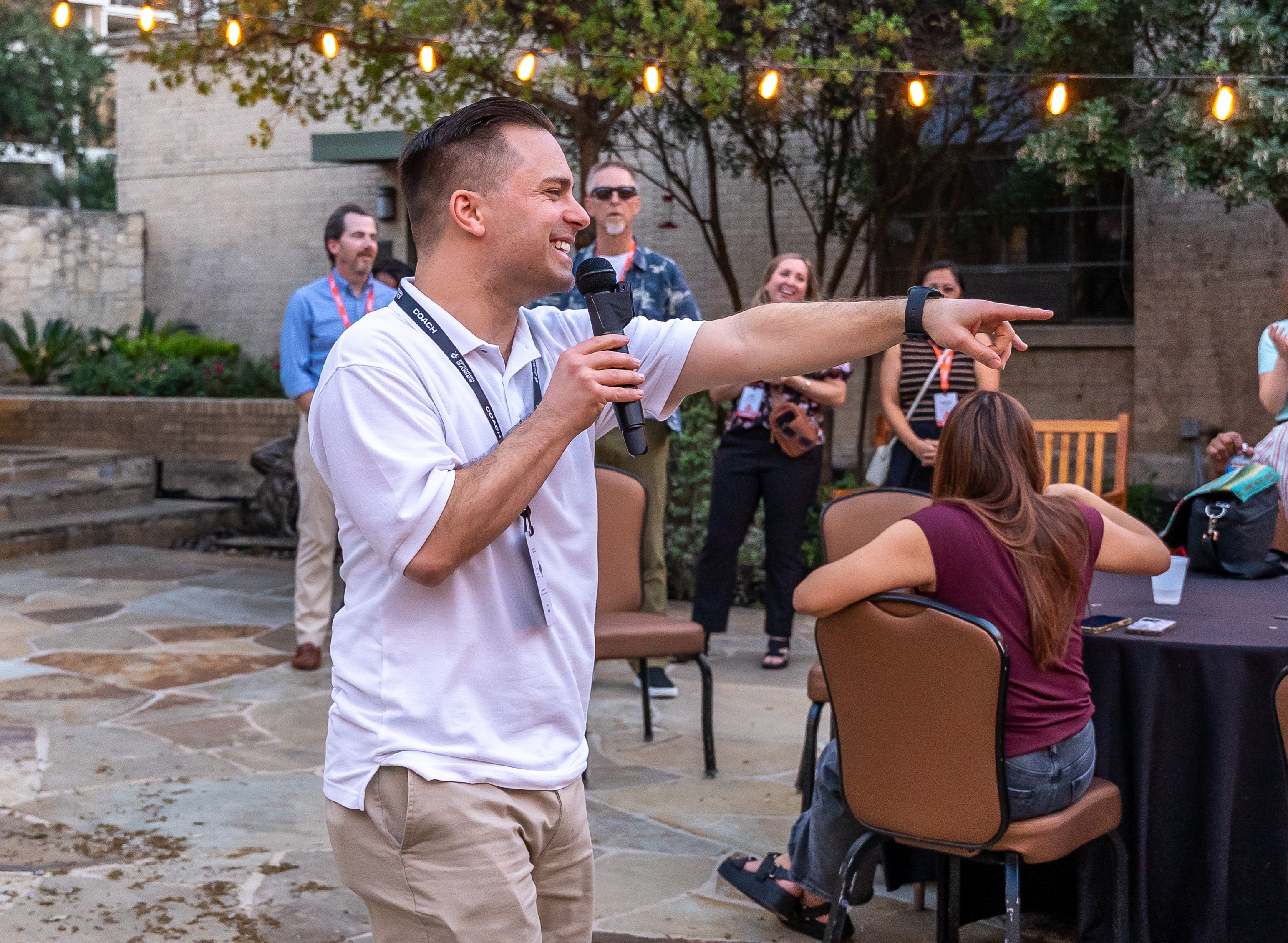





In exactly 3 hours and 58 minutes, I was about to break all of my own rules.
I was going to pitch a $12,500 event sponsorship live. On camera. With basically no preparation time.
If this went wrong, I might have to cut our catering budget for Sponsor Games in half. And that is NOT an option because Sponsor Games must have even better food than last year.
But here's the thing—I had three strategies that were either going to make or break this call. And you're about to see exactly how each one played out in real time.
Why This Was Stupidly Risky
Let me be clear: I almost never advise people to pitch live on a call.
It adds unnecessary pressure. You can't think deeply about your packages. You can't figure out proper pricing. You don't have time to hire me and my team in Wizard's Guild to help you strategize.
The smart move is to have a discovery call, take notes, then come back with a custom proposal.
But this situation was different.
First, Diony from Paperform had already told me they're working on something huge. Something mission-critical to their company. They're in a transition period, which means budgets are fluid and decisions need to happen fast.
Second, we already had great rapport from Sponsor Games 2025. I had a feeling they wanted to lock things in ASAP.
So I could play it safe—have a nice call, see how things are going, follow up later.
Or I could bet on myself, film everything, risk it all, and show them exactly why Sponsor Games 2026 is going to be completely different.
I chose chaos.
Strategy #1: The Direction Shift
Most people would jump straight into their pitch. "Here's why you should sponsor me. Here's what we're offering. Here's the price."
That's exactly what NOT to do.
When Diony mentioned they're working on something really big—something that sounds mission-critical to their company—that's a gold nugget. You need to pull that thread.
Instead of pitching first, I asked about their goals:
Tell me more about this new product direction
Are you pivoting the entire company to focus on this?
How are you thinking about promotions and launch strategy in 2026?
Here's the thing: Paperform is probably in a transition period. That makes allocating budgets for an event like ours potentially tricky. But understanding that and being empathetic to it? That's how you become one of their prized partners, not just another commodity.
And she opened up immediately.
"We've completely revamped our marketing," Diony said. "We cut our growth team, which was one of the hardest things I've ever had to do."
She admitted that marketing wasn't their strong suit. Her husband (and co-founder) is the product genius. She's great at operations. But marketing? They've been figuring it out as they go.
They tried hiring a full growth team. It disjointed their company. What actually worked? SEO and word of mouth.
This is exactly the kind of insight you get when you shut up and listen instead of pitching.
The Signal You Can't Miss
Then she said something that made my ears perk up:
"The feeling I have in my gut as a founder is very similar to when we launched Paperform. There's something about Stepper that feels really fantastic. Very innovative."
If you ever hear someone from a brand talk like this—"I've got this gut feeling, this conviction that this product is going to be a gamechanger"—that's a signal.
They may be willing to invest in awareness-focused goals versus conversion-focused.
Conversion-focused is when you've got the product dialed in. You know your marketing funnel. You know exactly how much you need to spend to get a customer.
But awareness? That's different. The metrics are squishier. The goal is just to spread the word. Get people excited.
And brands will pay differently for awareness than they will for direct conversions.
Strategy #2: The Feedback Loop
Here's what most people don't do: talk about what worked from last year and what didn't.
At our 2025 event, we did not have a good booth strategy. The event space wasn't super large, but we had some tables along the perimeter where sponsors could put swag and postcards.
Honestly? No one really went over to those tables. And I knew the sponsors noticed.
But there was a huge highlight: when I shouted them out from the stage (which wasn't even planned), R.J. from their team told me that was a massive win. And getting to interact with attendees at meals and dinners? That was awesome.
So I brought it up.
"Look, the tabling situation last year wasn't great. But the stage shoutout and the relationship building? That crushed."
Why would I bring up mixed results?
Because if there's an elephant in the room, they're thinking about it. So you should be the one to bring it up. Control that narrative.
This builds trust—especially when you're about to ask for MORE money.
Diony confirmed it: "Trust was really important. What I've found with events and sponsorship is we've worked with really big companies and the impact has been minimal. ROI has to be at the heart of everything."
She went on to say something I wish every brand understood:
"It's the responsibility of the sponsor to be very clear about what the return on investment they're looking for is. One of the hardest things for you in pitching is when there's no clarity from the sponsor on what that is."
I literally wanted to stand up and applaud.
The Power of the Referral
Then she dropped this:
"Sara Loretta was pivotal in that decision. Don't ever underestimate the power of the relationship you have with someone way before you get to any point where you're pitching them. Her ability to introduce us to you, then us getting to know you, then you continuing to have integrity in what you're doing—it really helped us make a decision."
I low-key was tearing up inside when she said this.
Integrity is one of the most important things to me in life and business. And to hear that it was THE thing that got the deal over the finish line? Right in the heart.
But notice the path: Sara introduced us. We built a relationship. I maintained integrity throughout the partnership. And now they trust me enough to consider sponsoring again.
That's how this actually works.
Strategy #3: The Future Vision
Now it was time to paint the picture of what Sponsor Games 2026 would be.
We're doubling the attendee size—capping it at 75 people instead of 37.
But more importantly, we have momentum. Last year, we had no hype video. No photos. People had no idea what to expect. I was basically like, "Trust me, it's going to be great."
This year? We have testimonials from attendees. Testimonials from sponsors. We're making it even more all-inclusive—catering breakfast, lunch, AND dinner.
And here's the kicker—the thing that made Diony's face light up:
"We'd love for our sponsors to financially commit to sponsoring an attendee at the event. Imagine someone walking away from Sponsor Games with a brand deal with Paperform by the time the event is over."
Her reaction: "Fantastic. That's right in the pocket of what we're looking for."
See what happened there? I wasn't just selling sponsorship. I was offering them a way to build relationships with creators in their target market. I was solving THEIR problem.
The Price Reveal
Time to lay it out.
"The investment for this year, given the increased headcount and format changes, will be $10,000 plus $2,500 to sponsor an attendee. So basically, a $12,500 obligation. What are your thoughts?"
$2,500 more than last year. Plus an additional commitment to fund an actual creator deal.
She paused.
"It hinges on what we decided in terms of our involvement. Where we found the most value last time was being involved in the games and providing our product."
Fair. She needed more clarity on how they'd be integrated. How the games would be different. How the event programming would change with double the attendees.
Then she asked directly: "Do you have any ideas about what the games will actually be?"
Totally reasonable question. She just wanted to see it all laid out before committing.
The Moment of Truth
I gave her some ideas. The brand speed dating concept where creators get to know sponsors. Using their product in challenges. Showcasing their new tool during networking sessions.
Then I did something probably stupid.
I asked point blank: "So is that a yes, Diony?"
She laughed. "All options are open to me."
Not exactly the answer I was hoping for.
But then she clarified: "Honestly, it's highly likely. We know you. We trust you. We got so much value in terms of brand, marketing, and relationships with influencers. We see the value in this in a very different way than other events."
She just needed that last 5% to push her over the line—clarity on how their products would be championed at the event.
What Actually Happened
I didn't get the sponsorship on the call.
And you know what? That's okay.
This is what happens sometimes. There can be extremely good vibes. The brand could have worked with you before and been really happy. And when you try to run it back, they say "maybe."
That can feel frustrating. I really wanted her to say yes right there. But she needed to see more. She needed scope of work. She needed clarification on brand integration. She probably needed to chat with her team about whether that budget—which was more than last year—made sense.
All of those things are totally reasonable.
The Lessons
Here's what worked:
1. Leading with curiosity instead of pitching Asking about their new product, their marketing challenges, their goals—that opened up the entire conversation. It wasn't me convincing them. It was me understanding them.
2. Bringing up the elephant in the room The tabling situation wasn't great last year. I said it. They respected it. It built trust.
3. Offering something they actually wanted The sponsored attendee deal? That made her face light up. Because it solved THEIR problem of building relationships with creators.
4. Having the courage to ask directly "Is that a yes?" might have been bold. But it gave me clarity on what I needed to do next.
Here's what didn't work:
Pitching live without a written proposal ready I should have had more details locked down about the programming, the integration points, the exact deliverables. That would have made it easier for her to say yes on the spot.
The Real Takeaway
You cannot give up when a brand doesn't say yes right away.
This is a process. It's a conversation. It's about understanding what they need, showing them how you can deliver it, and then giving them space to make the decision.
Most creators get deflated after one "maybe" and never follow up. That's leaving money on the table.
The brands that say "maybe" today could say "absolutely" tomorrow—if you keep showing up with integrity, keep solving their problems, and keep moving the conversation forward.
Want to learn how to have these high-stakes conversations with confidence? Join us in Wizard's Guild where we break down exactly how to structure discovery calls, create custom proposals, and negotiate deals that feel good for everyone.