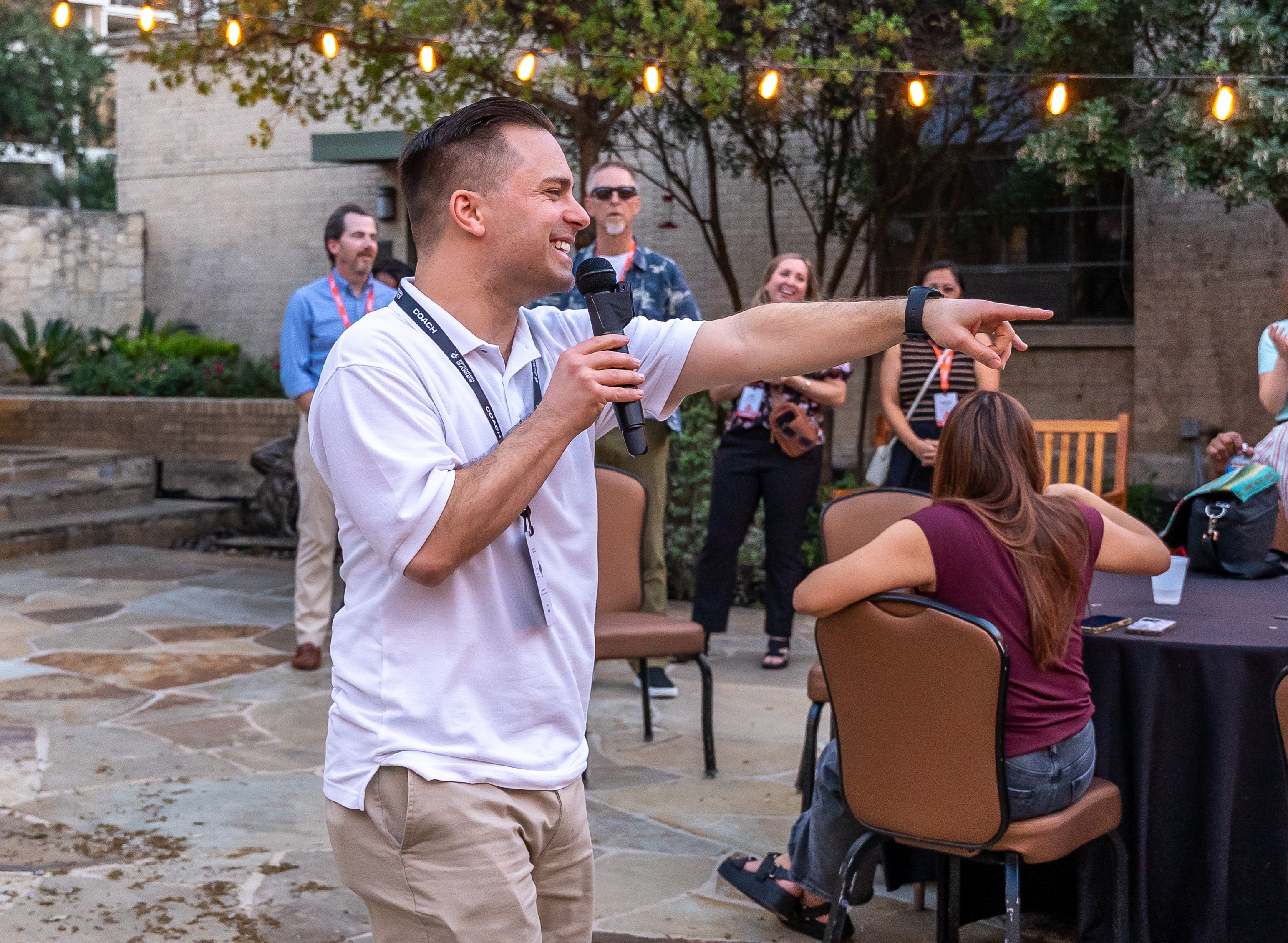





John Meese showed up to our call with a problem.
"Justin, I need your help. I have six weeks till my live summit. We have zero sponsors."
Here's what made this interesting: John isn't some rookie trying to figure out the creator economy. He runs Sold Out Coach Club (which is, true to its name, consistently sold out). He's written multiple books. His business is doing well.
But he'd just read The Science of Scaling and decided to stop playing it safe. He set a massive goal: help 100 authority business builders earn a million dollars each by 2028.
To do that, he realized he needed to stop only appearing on other people's stages. He needed to own his own stage.
So he created the Sell Smarts Summit—a virtual conference happening December 10th focused on "what's working now in online business." He texted a bunch of creators (including me) asking them to speak. Everyone said yes.
Now he had an event to run. Tickets were selling for a dollar. And he had zero sponsors locked in with six weeks to go.
Obi-Wan Kenobi/Justin Moore, you're my only hope.
The Problem With Planning Sponsorships at the Last Minute
Before we get into what John should do, let me tell you what he shouldn't have done: wait until six weeks before the event to think about sponsors.
I know that sounds harsh. But here's why timing matters so much.
Two days before our call, I got an email from Circle about their "Future of Communities Summit" happening November 18th—three weeks before John's event.
If John had started planning his summit six months earlier, he could have discovered Circle was hosting this summit in November. He could have positioned his event to happen before theirs and offered to promote their summit at his event as a key deliverable.
That would've been a slam dunk sponsorship. Circle clearly has budget allocated for this initiative. They're running ads. They're hiring creators to speak (I've been paid to speak at one of their summits before).
But because John's summit happens after theirs? Much harder sell. They've already spent their Q4 event budget.
This is the importance of planning sponsorships far in advance. Brands allocate budgets to their own priorities—their own campaigns, their own events, their own product launches. If you want their money, you need to figure out how sponsoring you helps them accomplish something they're already committed to doing.
The Data You Need Before Pitching Anyone
The first thing I told John: "What we're missing here is understanding where your registrants are at right now."
Most creators sit in a vacuum and think about which brands they personally love. "Oh, I use Circle, so they should sponsor my event!"
That's backwards.
What you need is a post-signup survey. After someone buys a ticket, incentivize them to answer five to seven questions. One of those questions should be about the tools, software, or brands that have helped accelerate their business over the last year.
Now you have ammunition.
Instead of saying, "Hey, I've got this summit coming up, you should sponsor it," you can say, "I've got early signals from 20 people who registered last week, and half of them mentioned your tool. I think you should sponsor this because we can expose you to the broader registrant pool who clearly have an affinity for what you're building."
That's a completely different conversation.
The second piece of data you need: is this an acquisition play or a retention play?
I'm literally talking with a prospective sponsor for Sponsor Games right now who asked me, "Tell me how to pitch this to my superiors. Is this a retention play or an acquisition play? Give me data so I know which department to get budget from."
Those are separate budgets at most companies.
If 25% of your registrants already own a Circle community, that's retention data. Circle might sponsor your event to reduce churn—show existing customers new features, remind them why they're paying, create a sense of community among users.
If most of your registrants are on LinkedIn but don't have private communities yet, that's acquisition data. Now you're helping Circle reach potential new customers.
Both are valuable. Both can get you sponsored. But you need to know which angle you're pitching.
The Creative Sponsorship Idea That Doesn't Actually Work
About halfway through our conversation, John pitched me an idea: What if sponsors could earn their sponsorship for free by promoting the summit?
"The sponsorship package is worth $5,000. But for every person who buys a ticket using your affiliate link, we'll mark $20 off the sponsorship price. Theoretically, if you promote the event enough, you could get the sponsorship for free."
Clever, right?
Wrong.
Here's the problem: that's probably two different departments at most companies. The person who holds the purse strings for event sponsorships is completely different from the content marketing person who owns promotion on their channels.
The event sponsorship person has a budget to spend. The content marketing person doesn't care about saving money on an event sponsorship—that's not their department, not their incentive structure.
You're essentially asking the event marketer to horse-trade with the content marketer, who has zero motivation to help.
For a small company like Senja where it's basically just founder Ollie making decisions? Maybe that could work. For bigger companies? You're creating unnecessary friction.
My advice: Don't negotiate against yourself by offering discounts upfront. Give them the number and shut up. Let them surprise you. Maybe they have end-of-year budget they need to spend and they'll just say yes at full price.
What John Should Actually Do (And What You Should Steal)
With six weeks to go and Thanksgiving two weeks away (at time of recording), John had a narrow window. Here's the action plan I gave him:
1. Add tool questions to the survey immediately.
John already had a post-signup survey asking about email list size and revenue. Great. But add questions about which tools registrants currently use or are interested in. That data becomes your pitch ammunition.
2. Research each potential sponsor for 30 minutes.
Don't just think about brands you personally like. Go look at their social media. Check their LinkedIn. See what their partnership leads are posting about. What campaigns are they running right now?
Circle just did a huge NYC billboard campaign. What was that about? They launched an AI bot challenge. What's the strategy there?
When you pitch, lead with THEIR priority: "Hey Alexis, I saw you guys are launching this new AI bot tool in Q4. I would love to help spread the word about that by sponsoring my summit."
That's completely different from "Hey, I've got this summit, you should sponsor it."
3. Apply the ROPE framework to every pitch.
I walk through this in detail in Sponsor Magnet, but here's the quick version:
R = Relevant to a campaign they're running now or have run in the past
O = Organic work that proves your audience cares about their product (link to past posts that performed well on related topics)
P = Proof from past partnerships (case studies, results, testimonials)
E = Easy to execute (specific deliverables, not vague promises)
4. If you can't lock sponsors, go the affiliate route.
Worst case scenario? Sign up to be an affiliate for Circle, Kit, Senja, or whatever tools you're using to run the event. Make a concerted effort to get summit attendees to sign up using your affiliate link.
Position it as serving your audience: "Let me show you the technology that powers my business. Here's this cool automation I built in Kit that helps me identify high-value leads..."
Then use that conversion data as proof when you pitch them for next year's event.
5. Create tiered packages tied to their goals.
Get them on a discovery call first. Ask about their priorities for Q4. Are they focused on awareness? Lead generation? Retention? Content repurposing?
Then create three to four packages where each one solves a different goal:
Package 1: Awareness play (newsletter mentions, event branding)
Package 2: Repurposing play (content they can use in their own channels)
Package 3: Lead generation play (speaking slot, demo session, attendee list access)
Package 4: Everything combined
The only way they accomplish all their objectives is by choosing the highest package.
The Heck Yeah Number
Here's the question most creators skip: What's your "heck yeah" number?
When you present packages, is your lowest tier priced at a number where if they say yes, you genuinely think "Heck yeah, let's go!"—not "Oh man, I was hoping they'd pick the bigger package."
Whether that's $2,000 or $10,000 depends on you. Your time. Your effort. What gets you excited.
Conspicuously absent from this conversation? Follower count. Reach. How many people will attend the summit.
None of that matters if you're not excited about the partnership.
John isn't betting payroll on these sponsorships. His business is already profitable. So the question becomes: at what number does adding sponsors feel like a genuine win rather than a distraction?
The Long Game Nobody Talks About
Here's what John said that I really respected: "I've already committed that the Sell Smarts Summit is an annual event every December. I want to take a long-term approach to this. What can I do this year that causes these sponsors to immediately think, 'Next year I really want to be a key part of this?'"
That's the right mindset.
Even if he doesn't lock sponsors for this year's event, he's building relationships. He's gathering proof. He's collecting data on what resonates with his audience.
Next year? He'll have attendance numbers. He'll have conversion data. He'll have testimonials from speakers and attendees. He'll have time to plan properly and reach out to sponsors six months in advance instead of six weeks.
First-year events are always the hardest to monetize. But if you overdeliver on the experience—both for attendees and for any sponsors you do land—you create momentum that compounds.
What This Means for Your Next Event (Virtual or In-Person)
Whether you're planning a virtual summit, an in-person conference, or even just a workshop, the principles here apply:
Start planning sponsorships 6+ months out. Find out what campaigns and initiatives your ideal sponsors are running. Position your event as a way to amplify something they're already committed to doing.
Collect data on your audience ASAP. Don't wait until after the event. Survey registrants immediately to understand their tools, challenges, and goals. That data becomes your pitch.
Stop thinking about what you want to offer. Start thinking about what problems sponsors are trying to solve and how your event helps them solve those problems faster.
Have a backup plan. If you can't lock paid sponsorships, use affiliate relationships to gather proof for next time.
Price based on what gets you excited, not based on some formula tied to your audience size.
The creator economy is full of people running free summits with sketchy replay upsells and mediocre experiences. If you actually care about delivering value—to both your audience and your sponsors—you'll stand out.
John's doing it right by charging a dollar for tickets (skin in the game without being a barrier) and including all replays. No bait-and-switch. No aggressive upsells. Just a solid event that serves his audience.
If you want to see how this plays out, grab a ticket at creatorwizard.com/smarts. That's my affiliate link, by the way—full transparency.
And if you're trying to figure out your own sponsorship strategy for an event, a podcast, a newsletter, or literally any creator platform? We work through exactly these scenarios inside Wizard's Guild, my sponsorship coaching program.
Because here's the truth: most creators don't fail at landing sponsors because they don't have enough reach. They fail because they're pitching the wrong thing at the wrong time to the wrong person.
Fix those three things, and suddenly six weeks doesn't feel nearly as impossible.