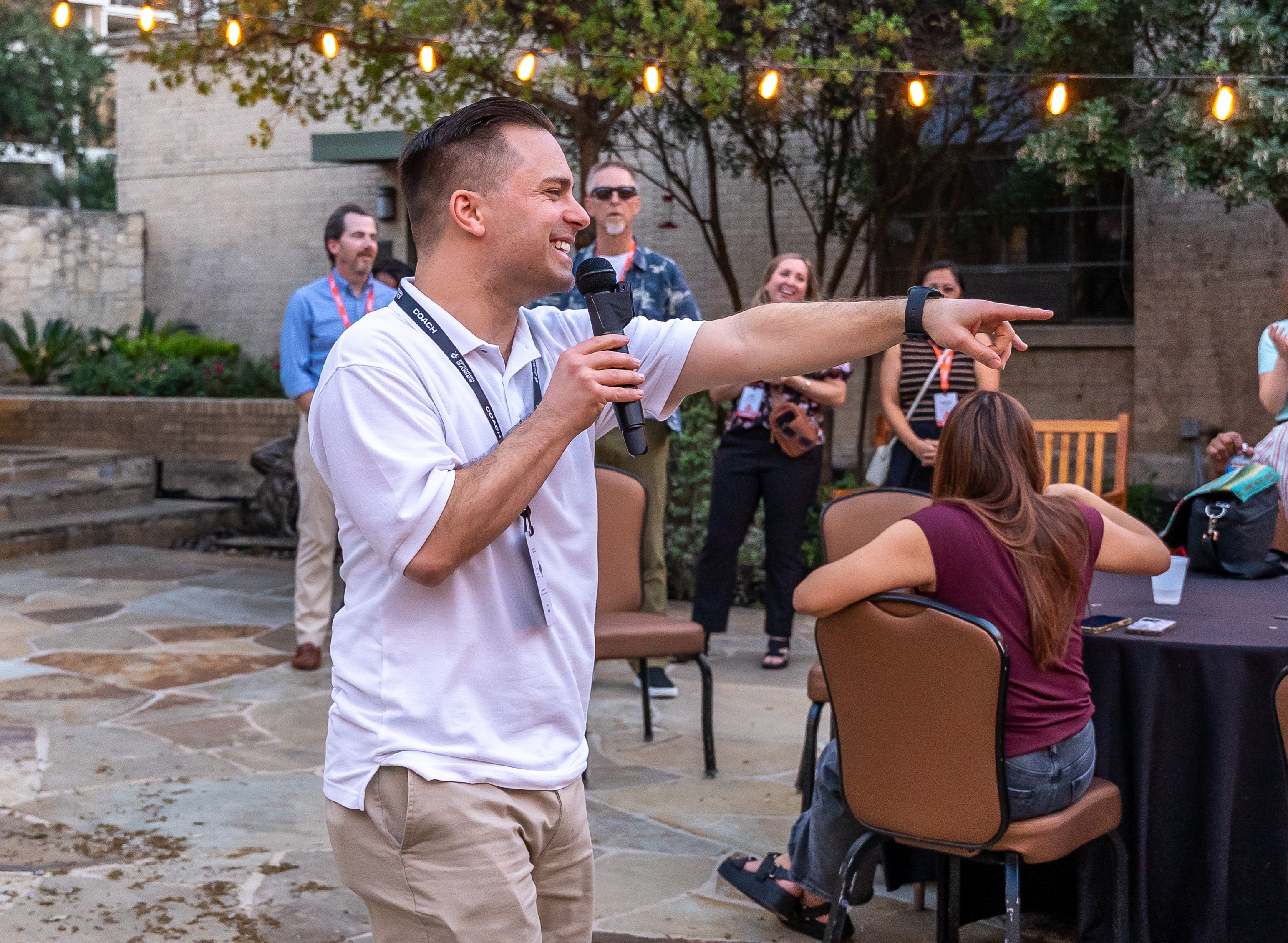





I wasn't expecting to learn anything at my mom's award ceremony.
Sharon Moore has been a dietitian for 50 years, and the Minnesota Academy of Nutrition and Dietetics was honoring her for it. So me, April, and the family showed up to celebrate her, and I'm proud we did. But when I walked in and looked at the room, I couldn't help myself.
Five sponsors.
A breakfast sponsor. A lunch sponsor. Speaker sponsors. Five brands had paid to be at a conference most people have never heard of, in front of a room of maybe a few hundred people.
And then someone tapped me on the shoulder.
I turned around, and it was Anna, one of my coaching clients, standing there in the middle of this niche dietitian conference. Of all the places.
Here's the thing: that moment wasn't a coincidence. It was proof.
The Brands Are Already There. You Just Have to Show Up.
Anna's story is one I want you to sit with for a second.
She's a dietitian who decided to go on GLP-1 medication. When she went looking for trustworthy resources on nutrition and diet while on the medication, she couldn't find much. So she built it herself, a podcast, a newsletter, a whole resource. She was not a creator in the influencer sense of the word. She had spent her career helping clients and doing health writing for brands. But she saw a gap, filled it, and the brands came knocking almost immediately.
She joined Wizard's Guild because she needed help navigating the tidal wave of inbound interest. That's a good problem to have. But it's also a new and disorienting one when sponsorships are a totally foreign concept and you've built your whole identity around clinical expertise.
Now here she is at a niche dietitian conference, not waiting for brands to find her, but walking over to their sponsor tables, introducing herself, letting them know about her podcast and her audience.
On her way out through the airport, she told me she'd just closed another very lucrative deal.
That is not an accident. That is someone who understands where the money is hiding.
Big Fish, Small Pond
Look at the brands at that conference. Abbot. The Pork Board. These are not small companies. Someone approved a budget line item to sponsor a regional dietitian conference with a few hundred attendees instead of a massive expo with thousands.
Why would they do that?
Because a few hundred of the exact right people is worth more than ten thousand random ones. Practitioners. Registered dietitians. People whose professional recommendations carry weight with patients. That kind of audience is nearly impossible to reach efficiently through Google ads or Meta campaigns, especially in a regulated healthcare space where digital advertising gets complicated fast.
This is the same reason Paul Jamison built a lucrative sponsorship business with the Green Industry Podcast. His audience is lawn care contractors and pro-sumers, the exact customers that Lowe's, Toro, and John Deere want to reach but can't easily find. There aren't many credible voices speaking directly to that community. Paul is one of them. So the brands come to him.
Same story with Dr. Alex of Digital Pathology Place. She's a veterinarian with a YouTube channel and podcast. The brands in her space? Their alternative is advertising in a trade magazine that sits unread in a waiting room, or trying to navigate pay-per-click in a medically regulated niche. Or, and this is what they're increasingly choosing, they fly Dr. Alex out to their facility, put her on stage at industry events, get their director of R&D on her podcast as part of a full 360 collaboration.
You don't need a massive audience to be someone a brand desperately needs. You need to be a big fish in the right small pond.
The Part That Feels Frustrating (But Actually Isn't)
Here's what I hear from a lot of professionals who have built genuine expertise and a real audience: the brands in their space either don't know they exist, or they do know and they're offering free products instead of actual money.
I get why that's infuriating. But I want to reframe it for you.
In a lot of traditional industries, the biggest brands have literally never worked with a creator or podcast host. They don't have a process for it. Their legal team has questions. Their marketing department doesn't have a line item for it. It's not that they don't see the value, it's that no one has ever walked them through it.
That's your job now.
Yes, it might mean multiple Zoom calls. It might mean going to their facility and sitting in a boardroom with their executive team. It might mean 9 months, 12 months, 18 months before a budget gets approved.
But here's what happens on the other side of that: you become the only person they think of. Because you were the one who educated them. You shaped how they think about this entire category of marketing. When they finally get the green light, they're not shopping around. They're calling you.
That is how you introduce real predictability into your sponsorship income. You stop wondering what's coming in next month and you start knowing, because you planted those seeds a year ago and now they're bearing fruit.
A Note for Anyone Living a Double Life
Maybe you're reading this as a doctor, a lawyer, a practitioner of some kind, someone with credentials and a real professional identity. And somewhere in the back of your mind is this thought you barely let yourself finish: what if I actually did this full time?
It probably feels ridiculous. Maybe even a little embarrassing to say out loud.
I had my own version of that fear. When I shut down my influencer marketing agency to focus on Creator Wizard full time, I genuinely worried: will people still take me seriously if I'm not in the trenches with brands every day? Will the credibility transfer?
That fear is just impostor syndrome wearing a very convincing costume.
The creators who've taken that leap, Anna, Paul, Dr. Alex, and many others I've worked with, aren't less credible for building an audience around their expertise. They're more reachable, more trusted, and frankly more influential than they were before. Because now they have distribution.
And the amount of money that becomes possible when you have distribution and deep subject matter expertise is genuinely hard to comprehend until you're in it.
Bet on yourself.
The Move, If You're Anna Right Now
If any of this sounds like your situation, you've got the expertise, you're starting to get inbound interest, and you have no idea how to price a deal, structure a package, or respond when a brand asks for five deliverables you've never negotiated before, that's exactly what we work through inside Wizard's Guild.
And if you want to understand this whole world before jumping into coaching, start with Sponsor Magnet. It's everything I know from 550+ deals and $5M+ in sponsorships, written specifically for people who are great at what they do and just need the roadmap for turning that into brand partnerships.
The brands in your niche are already sponsoring things. The question is whether they know you exist yet.
Are you showing up where your future sponsors already are, or are you waiting for them to find you?